
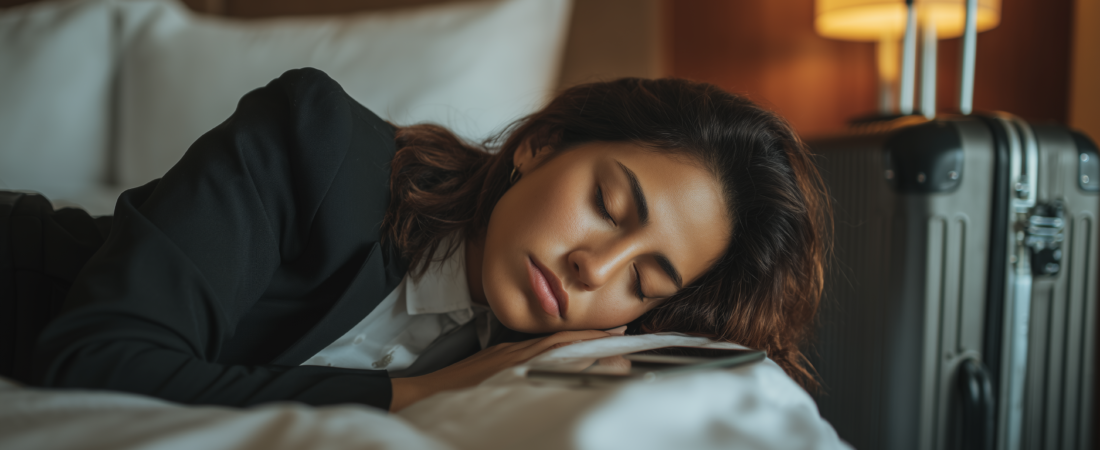
How Jet Lag Steals Your Adventure (And What You Can Do About It)
You’ve saved for months, packed your bags, and finally landed in the destination of your dreams — but your body thinks it’s 3 a.m. Your eyes ache. Your mind keeps drifting. The Eiffel Tower loses a lot of its appeal when you can barely keep your head upright.
Jet lag is not just tiredness. It is clinically recognized as the circadian rhythm disruption that occurs when rapid trans-meridian travel puts your internal body clock out of sync with the local environment. You know the symptoms: daytime fatigue, disrupted sleep, impaired concentration, digestive upset, and mood disturbances — all of which can last for several days after arrival. The good news? Jet lag is not inevitable. Sleep scientists, circadian biologists, and physicians now have a clear, evidence-based picture of how to minimize it. The five techniques below represent the highest-rated interventions in current medical research. Each one targets the root cause: circadian misalignment.
1. Strategic Melatonin — The Most Evidence-Backed Supplement for Jet Lag
Of all the pharma and supplement tools available to travelers, melatonin has the strongest evidence base for combating jet lag. Melatonin is the hormone your pineal gland naturally releases in response to darkness. It signals to your body that it is time to sleep and plays a direct role in resetting your internal clock when you arrive in a new time zone.
A landmark Cochrane systematic review — the gold standard of medical evidence — analyzed ten randomized controlled trials and found that melatonin taken close to the target bedtime at the destination (between 10 p.m. and midnight local time) significantly decreased jet lag symptoms in travelers crossing five or more time zones. Doses between 0.5 mg and 5 mg produced similarly effective results.
A subsequent meta-analysis published in PubMed (Herxheimer & Petrie, Cochrane Database of Systematic Reviews, 2002) concluded that melatonin is “remarkably effective” in preventing or reducing jet lag, and that short-term use appears to be safe. A further 2015 meta-analysis combining evidence from four systematic reviews and eleven randomized trials confirmed that oral melatonin “probably reduces symptoms associated with jet lag syndrome,” with any side effects likely mild.
How to use it:
- Take 0.5–5 mg of melatonin at the target bedtime of your destination, starting on your first night there.
- For eastward travel (the harder direction), begin taking it the evening before you fly.
- Avoid taking it at the wrong time — melatonin taken in the middle of the day at your destination can actually worsen circadian misalignment.
“Jet lag is for amateurs.”
– Dick Clark, legendary TV host and prolific global traveler, who reportedly refused to let time zone disruption derail his schedule.
2. Use Strategic Light Exposure to Reset Your Circadian Clock
Light is the most powerful environmental cue your body uses to set its internal clock. Your suprachiasmatic nucleus (SCN) — the master clock in the brain — is exquisitely sensitive to light, particularly in the blue-wavelength part of the spectrum. Exposing yourself to light at the right time of day can shift your circadian rhythm forward or backward by hours in a single day.
A 2024 systematic review published in Cureus (Ahmed et al., DOI: 10.7759/cureus.71316), which analyzed 23 high-quality studies conducted between 2020 and 2024, found that personalized light exposure was among the most effective non-pharmacological interventions for reducing jet lag symptoms and improving sleep quality after trans-meridian travel. The review advocates for combining light therapy with melatonin for best results.
Stanford circadian physiologist Dr.Jamie Zeitzer, a Professor of Psychiatry and Behavioral Sciences at Stanford University, has noted that light is one of the most powerful natural remedies for jet lag, with particular potency during the hours of habitual sleep, when the SCN is most sensitive to phase-shifting signals.
A 2021 meta-analysis of 21 randomized studies (published in PMC, DOI: 10.1186/s13063-021-05178-9) found that light therapy produced “large treatment effects on circadian phase shift,” with medium-to-high intensity exposure (2,000–8,000 lux) over one to three hours delivering the most significant clock resets.
How to use it:
- Traveling east: Seek bright morning light at your destination. Avoid evening light for the first day or two.
- Traveling west: Seek bright evening light. Avoid early-morning sun exposure.
- Use a 10,000-lux light therapy lamp or spend 30–60 minutes in direct outdoor sunlight at the appropriate local time.
- Apps such as Timeshifter (developed with circadian scientists) calculate your optimal light exposure windows based on your specific itinerary and chronotype.
3. Pre-Shift Your Sleep Schedule Before You Fly
Most travelers board their plane without having made a single adjustment to their body clock. This is a missed opportunity. Shifting your sleep and wake times in the days before departure gives your circadian rhythm a head start and significantly reduces the severity of jet lag on arrival.
Dr. Michael Scullin, Ph.D., Director of the Sleep Neuroscience and Cognition Laboratory at Baylor University, recommends the following approach: “Four to five days before an international trip, start going to bed and waking up half an hour earlier each night, increasing another half hour incrementally. But it wouldn’t be about just changing bedtimes — you should change all your mealtimes, timing of exercise, timing of early morning light exposure, reduction of evening light exposure and other routines as well.”
Dr. Cheri D. Mah, MD, MS, sleep physician at Stanford Lifestyle Medicine, echoes this principle, noting that most people “just jump on an airplane and then try to adjust their body clock after they arrive, which is not really a plan.”
How to apply it:
- Eastward travel: Go to bed and wake up 30 minutes earlier each day for four to five days before departure.
- Westward travel: Shift your schedule 30 minutes later each day.
- Adjust mealtimes and light exposure alongside sleep timing, as these cues reinforce each other.
- Avoid long naps and excess caffeine on travel days, as both delay the body’s ability to acclimate to the new time zone.
4. Align Your Meal Timing with Your Destination’s Time Zone

What you eat — and when — sends powerful signals to the peripheral clocks in your organs, including your liver, gut, and metabolic system. These peripheral clocks can be shifted by meal timing independently of the master clock in your brain. Travelers who eat meals aligned with their destination’s time zone accelerate their full body-clock reset.
The 2024 Cureus systematic review (Ahmed et al.) specifically identified time-restricted eating as one of five evidence-supported interventions for jet lag management, recommending “a personalized, integrative approach that combines melatonin, light therapy, time-restricted eating, exercise, and alternative therapies.”
Research published in Nutrients (Desmet et al., 2021, University of Leuven) demonstrated in animal models that time-restricted feeding prevents the disruption of peripheral circadian clocks and mitigates the metabolic consequences of chronic jet lag. Human circadian researchers have extended this principle: restricting eating to daytime hours at the destination while fasting during your old home-time eating window is a practical strategy for travelers.
Biohacker and human performance researcher Gary Brecka has made a similar point in public commentary: “For faster adjustment to new time zones, avoid eating during your normal sleep window in the first 48 hours while also getting sunlight exposure.”
Dr. Scullin also cautions against heavy or sugary meals and alcohol during the flight itself, noting that “when we eat heavy meals, sugary treats and imbibe alcoholic beverages during travel — and then are immobile for several hours on a plane — the symptoms of jet lag are more likely to emerge.”
How to apply it:
- On the day you fly, begin eating meals on your destination’s schedule rather than your home time zone’s schedule.
- Avoid alcohol and heavy meals inflight; stick to light, easily digestible food and water.
- Once you land, eat breakfast, lunch, and dinner at the local times — even if you are not hungry. This anchors your metabolic clocks to the new environment.
Aim for a consistent eating window of 8–10 hours aligned with local daytime.
5. Exercise at the Right Local Time After Arrival
Physical exercise is a potent but underused circadian ‘zeitgeber’ — a time cue that helps reset your body clock. Exercise raises core body temperature, triggers cortisol release, and suppresses melatonin, all of which signal alertness and wakefulness to your circadian system. Timed correctly, a bout of moderate exercise can accelerate your adaptation to a new time zone by a full day or more.
The 2024 Cureus systematic review (Ahmed et al.) lists exercise as one of the five evidence-supported strategies in its integrative approach to jet lag management. Research into circadian chrono-modulation consistently shows that exercise in the morning or early afternoon at the destination reinforces the new wake-phase signal, while evening exercise can have the opposite effect.
Dr. Brian Morton, former Chair of the Council of General Practice at the Australian Medical Association, observed that many of the behavioral factors that worsen jet lag — including inactivity and poor sleep discipline — are within the traveler’s direct control: “Smart companies get their executives there the day before a critical meeting,” he noted, “precisely to allow time for light, movement, and recovery”.
How to apply it:
- After landing, aim for 20–40 minutes of moderate aerobic exercise — a brisk walk, jog, or gym session — in the morning or early afternoon of your destination’s local time.
- Exercising outdoors combines the circadian benefits of both physical activity and natural light exposure.
- Avoid vigorous exercise within two to three hours of your new local bedtime, as it can delay sleep onset.
- Even light movement — a walk around the block or a gentle stretch — is substantially better than remaining sedentary in a hotel room.
Conclusion: A Holistic Strategy Beats Jet Lag at Its Source
Jet lag is a disruption of biology, not willpower. Your body is not being difficult — it is simply following the rhythms it was built to follow. The five techniques above work because they all address the same root cause: they give your internal clock the signals it needs to shift to the new time zone faster.
Used together, they form a coherent strategy: pre-shift your schedule before departure, use melatonin at the right time upon arrival, seek or avoid light according to your travel direction, eat on the local schedule from the moment you land, and move your body during the day at your destination. The science is consistent. Jet lag is not something you have to simply endure. Treat it as a physiological challenge with evidence-based solutions — and with the right preparation, you can step off a long-haul flight ready to explore!